
Speaking & Lectures
I do not give standard motivational talks. I tell the truth about what it means to survive, to be seen, and to change a system from the inside. Every talk is adapted to the room, from a global summit to a school classroom. I speak English, French, German and Swiss German.
My approach to storytelling is simple: the people in a story are its authors, not its material. I help organisations, schools and audiences understand what respectful community storytelling looks like, and what it costs when dignity is treated as decoration.
Tell me about your event, your audience and your date. I answer every message personally. Whether you need a keynote on ethical global health leadership, a lecture on community representation, or a speaker who has stood in both worlds: one email is enough.
Signature talks at a glance
Poverty Porn: How Aid Fundraising Betrays the People It Shows
28 Operations: What Resilience Really Means
The Disease the World Ignored
Whose Voice Is It? Power, Images and Ethics in Global Health
Beyond the stage: I also advise NGOs, foundations and health institutions directly. See "For organisations" below.
The philosophy behind my talks
True leadership and resilience are not born in theory. They are forged in the reality of lived experience. Over years of advocating on the front lines of global health, addressing international assemblies and championing equitable partnerships, my work has been driven by one principle: dignity is not optional. I believe our deepest challenges can become our greatest sources of insight, purpose and trusted leadership. That is what I bring to every stage.
Signature keynotes
Poverty Porn: How Aid Fundraising Betrays the People It Shows
For decades, aid has been sold with images of suffering. I show what this does to the people in the pictures, and how organisations can raise money with dignity instead. Sharp, honest, and full of practical answers your audience can use the next morning.
Why me: I grew up as the child in those photographs, and today I advise the institutions that publish them. Nobody else in this field speaks from both sides of the camera.
28 Operations: What Resilience Really Means
Resilience is not a poster word. It is a daily decision. My story of surviving Noma, growing up between Burkina Faso and Switzerland, and turning pain into purpose. Personal, warm, and unforgettable.
Why me: I do not teach resilience from books. I lived it 28 times, and audiences feel the difference within the first minute.
The Disease the World Ignored
Noma kills children in the poorest places on earth, and almost nobody knew its name. This is the inside story of the campaign that put it on the WHO list of neglected tropical diseases, and what it teaches us about changing global policy.
Why me: I co-founded the survivors association and ran the campaign myself. This is not a case study I read. It is one I wrote.
Whose Voice Is It? Power, Images and Ethics in Global Health
Who gets to tell the story of a community? A talk about narrative power, ethical imagery, and why lived experience belongs at the decision table, not in the footnotes.
Why me: I have been the voiceless subject, the survivor founder and the institutional advisor. I know all three seats at the table, because I have sat in them.
For universities and schools
Dignity and Ethics in Research, Life and Imagery
A lecture or workshop for students, researchers and clinicians. We look at real cases: how images are chosen, how patients are described, how communities are included or excluded. Interactive, honest, and adapted to the age and field of the audience.
Why me: I am a patient of the system your students will one day run, and a published co-author in global health research. I bring the case study and the syllabus at once.Academic masterclasses: custom guest lectures and curriculum insights for university departments and global health institutes, moving beyond the case study to real-world impact.
Clinical masterclasses: specialised briefings for clinicians, researchers and healthcare workers on the realities of Noma and skin NTDs.
School visits: an age-appropriate talk about difference, respect and inner strength.
Also on stage
Expert panels and strategic representation at summits, symposia and parliamentary sessions.
Strategic moderation for leadership retreats and institutional dialogues.
Ceremonial speeches (laudatio) for anniversaries, awards and institutional milestones.
Executive message architecture
For ministers, CEOs and directors who carry a message that matters: I craft and refine high-stakes addresses, review institutional messaging for ethical clarity, and coach presence and delivery for boards, summits and public assemblies. Discreet, personal, and built around your voice, not mine.
A note on mentoring
Beyond the stage, I accept a strictly limited number of one-on-one mentoring clients: people navigating significant career or personal transitions who want a confidential sounding board. Resilience mentoring, narrative ownership, executive and life strategy. Mentoring is accepted by consultation only, and I do not advertise it. If this is you, write to me personally.
For organisations: advisory & diagnostics
A keynote changes a room for an hour. Some organisations want the deeper work: changing how they communicate, decide and serve the communities they exist for. Three ways to work with me beyond the stage. Formal evaluations run under the framework of ALETHEIA TUTELA, my advisory firm.
The Dignity Diagnostic
A fixed-scope review of your public communication: your imagery, campaigns and reports, two to three conversations with your team, then a written report with concrete fixes and an imagery checklist your team can actually use. Remote, two to three weeks, fixed price. Why me: I was once the child in the campaign photo. I have sat on every side of this table, and I can tell you in days what test groups debate for months.
The Strategy Day
One full day with your leadership or communications team: where your public story drifts from the reality of the people you serve, what to change, and how. You leave with decisions and a written recommendations page, not a workshop high. Why me: I built an organisation from a blank page and took a forgotten disease to the WHO list. Strategy is only real if it survives contact with reality.
The Strategic Retainer
Ongoing senior advisory, like my mandate with the Swiss Tropical and Public Health Institute: regular counsel, on-call availability, and a lived-experience voice in your leadership conversations. Six-month minimum. Why me: institutions keep me because I say the true thing early, kindly and in plain language, before it becomes expensive.
Tell me what your organisation is struggling with. I answer every message personally, usually within two working days.
SEE ME ON STAGE
Shaping the global conversation on resilience, policy and health equity. Selected addresses, as delivered at the time.
Booking
Tell me about your event, your audience and your date. I answer every message personally.
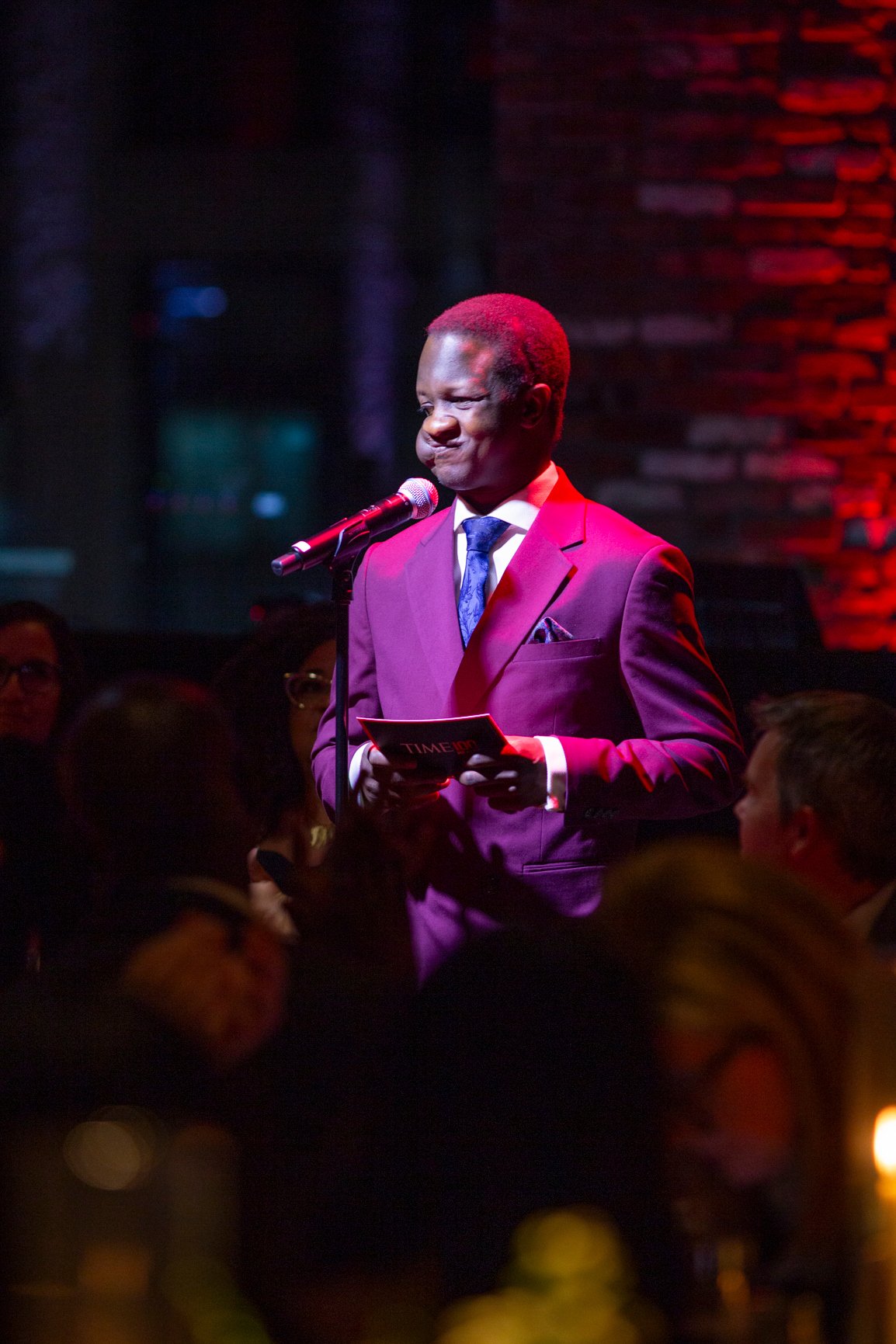
The Impulse: New York Address
(TIME100 Impact Dinner: Leaders Shaping the Future of Health)
Transcript
"Tonight, I would like to give a toast to celebrate life. And I’m not saying this lightly.
I was born in one of the poorest regions of the world, affected by one of the most devastating diseases. Up to 90% of the people affected by Noma don’t make it. And still, I am here today with you.
I don’t know why I survived. Science doesn’t have answers yet. But I know that many people like you, dedicated professionals who are pushing boundaries, contributed.
When Dr. Zala first met me, I was just skin and bones. He had very little hope, but still, he literally fought to save my life. Later, many others contributed to improve my health and quality of life. I went through 27 surgeries to reconstruct my face. And just learning to blow out a candle took me three years through speech therapy.
At one point, I decided to take action. As Mulikat, the co-founder of Elysium, aptly says: 'There is ability in disability.'
No matter the challenges you face along the way, never underestimate the power of people’s capabilities.
Remember, and let no one convince you otherwise. Your sheer determination and hard work have an impact. Your achievements are inspiring. And I am convinced that together, we can make a change in this world.
So let’s celebrate our collective hope, the dream we dare to chase, the future we shape together, the ones who are no longer with us, and the ones we have not met yet.
To us, and to life, may our actions echo far beyond these walls."
The London Address (APPG - House of Lords)
Strategic Policy & The Human Cost of NeglectDelivered at the UK Parliament | January 31, 2024
Transcript
"My name is Fidel Strub. I was born in Ouagadougou, Burkina Faso. Around the age of three, I was infected by a little-known disease called Noma, which ignited a battle for survival that would span nearly two decades.
The pain began as a subtle pinch in the right cheek. My parents realised early on that something was not right as my health was declining rapidly. They brought me to doctors, but they didn’t know what it was or what to do. Noma was destroying my face at an alarming rate.
By sheer luck, a Swiss organisation had started a radio campaign asking to bring every child with a hole in the face to the north of the country, where one doctor, Dr. Zala, knew what to do. This led to my proper diagnosis and treatment, but Noma had already taken a devastating toll. It destroyed half of my lips, my nose, and my cheekbone. My right eye was lower than where it should be. My palate was gone, and with it, the muscles necessary for basic functions like chewing and speaking. My dignity was also taken away.
The damage to my face was so extensive that I was sent to Switzerland and adopted by Swiss doctors. My mother would say that I adopted her; she was always by my side and the only familiar face in a country where everything was new.
Over the next 15 years, I endured a total of 27 surgeries to reconstruct my face, six years of daily speech therapy, and psychological treatment. Every step took years. Just learning how to blow out a candle took me half a year. This was a very lonely and hard fight which tested my mental limits a few times. But I was, and still am, lucky that I had access to all this support.
After overcoming my mental battles, I decided to take action. We know how to prevent and treat Noma; we cannot wait to act. Experts estimate the disease affects 140,000 people every year, and up to 90% of them die in just a few weeks.
We share our survival stories to show how much Noma actually affected us and why we cannot accept that it still exists. All of this could have been avoided if there was awareness.
We want to ensure people at risk and their communities are educated about Noma, and people affected by it are treated on time. Furthermore, we want to give survivors the chance to reclaim their lives and dreams. We want to make it possible for them to pursue an education or start their own business. We want them to be empowered, as we have been, so they can make a fruitful contribution to society as they deserve.
We believe our stories, filled with pain but also with resilience and hope, can serve as catalysts for change, inspiring a movement that vows to protect future generations from the cruelty of Noma and all Neglected Tropical Diseases."
APPG Official Report (UK Parliament)

“Fidel Strub spoke passionately about surviving noma, his journey through countless reconstructive surgeries, and his drive to get more attention to both this cruel disease and oral health, so that no other child has to suffer so long after noma.”
The Global Health Address (London)
The Power of Voice: Radical Advocacy & Elimination Milestones Delivered at the World NTD Day Forum (Co-hosted by the WHO, UAE Embassy UK, and Reaching the Last Mile) | January 30, 2024
Transcript
My name is Fidel Strub, I was born in Burkina Faso and I’ve survived a little-known disease called noma which was officially included in the list of Neglected Tropical Diseases of the World Health Organization just a month ago. Noma is a fast-progressing disease that we know how to prevent and to treat. Experts estimates it affects 140,000 people every year and up to 90% of them die in just a few weeks. I’m here today but it means 9 others didn’t make it and this is not acceptable.
My journey of living and surviving noma is a story of pain, perseverance, and illustrates the power of timely intervention. I simply survived thanks to an outreach of a Swiss organization that redirected my path from one of despair to one of hope. They had just trained a local doctor, Dr Zala, to treat noma and they were making announcements on the radio to bring all with a hole in their face to him. My grandmother heard this message, and this is ultimately what saved my life.
The scars on my face that I carry until today are physical but they are also a little window into the scars in my soul. They tell the story of 27 surgeries, relentless speech therapy, and a battle with depression that tested my willpower to its limits. These scars are a testament to my survival and my resilience, and they are a reflection of what so many endure when they face diseases like noma, river blindness, and other neglected tropical diseases.
"Reaching the Last Mile" stands as a beacon for all of us who believe in the right to health, dignity, and life. This organisation’s tireless efforts echo the very essence of my journey — that in the world's most remote corners, hope can be found, lives can be saved, and futures can be reclaimed.
We gather here to champion a cause that is greater than any one of us. Noma shouldn’t exist anymore as well as other NTDs. As "Reaching the Last Mile" has shown us, no mile is too far, no effort too great, no investment too small in the quest to bring healing and health to all.
In sharing my story, I hope to inspire not just empathy, but action. I hope to ignite that passion for justice and a commitment to reach every last mile, every last person, and every last child. Our journey is far from over, but together, we are forging a path towards a future where no one is left behind.
Thank you for being part of this mission, for listening, for caring, and most importantly, for acting. We, at Elysium, the first noma survivors association, that I’ve cofounded with Mulikat Okanlawon, are looking forward to working with you
Thank you.
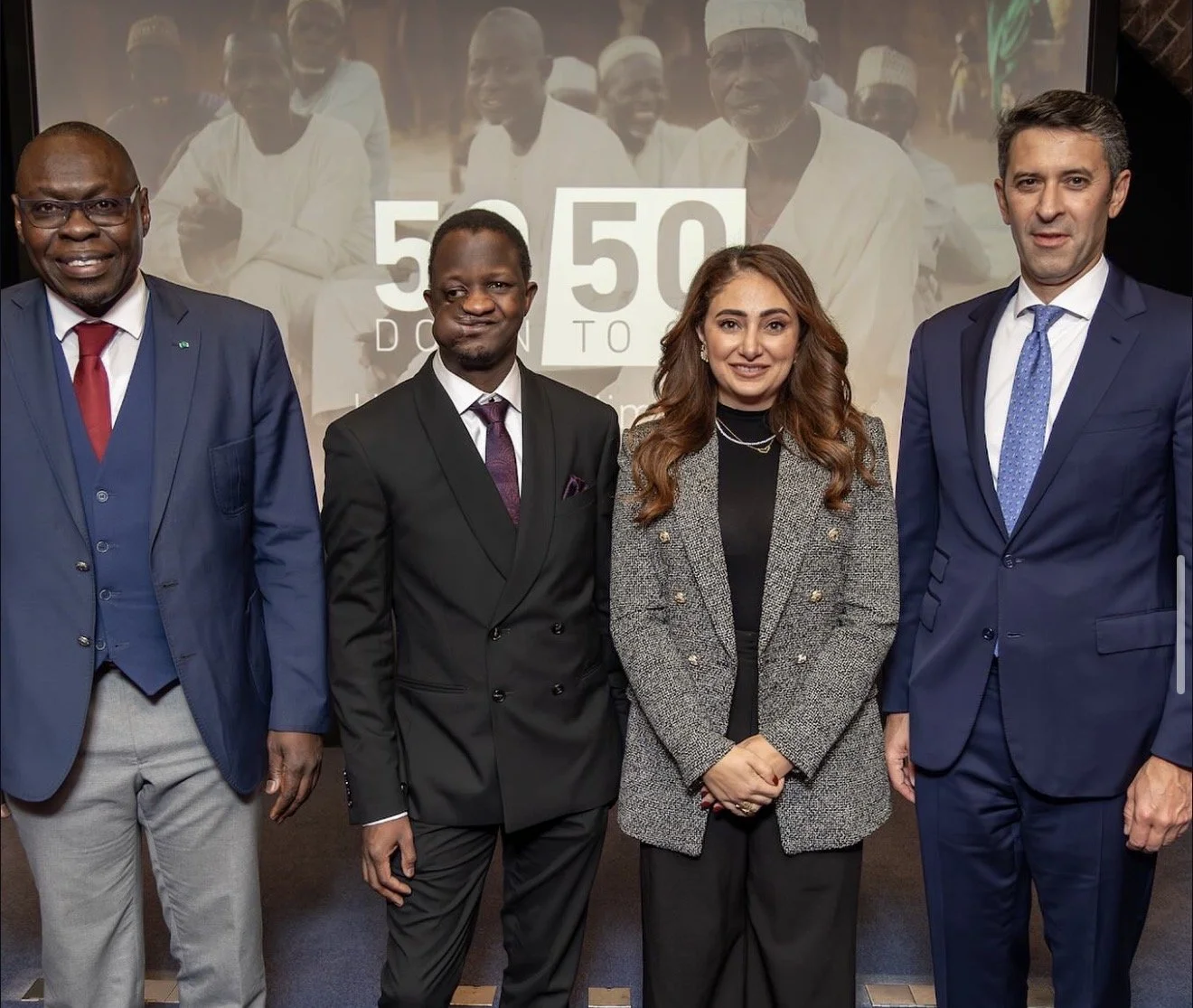
From left to right:
Dr. Ibrahim Socé Fall, Former WHO Director of the Global Neglected Tropical Disease Program
Fidel Strub
Tala Al Ramahi, Chief Strategy Officer of Reaching The Last Mile (RLM)
H.E Mansoor Abulhoul, UAE Ambassador to the UK
Booking
Tell me about your event, your audience and your date. I answer every message personally. Whether you need a keynote on ethical global health leadership, a lecture on community representation, or a speaker who has stood in both worlds: one email is enough.